GDG-B100 Mudman the £200 G-Shock that swaps solar for a MIP screen
The GDG-B100 is Casio's first Mudman with a memory-in-pixel screen, a red backlight, step counting and phone notifications, for a £200 RRP. It suits outdoor workers, walkers and runners who want a mud-sealed G-Shock that also logs runs. The catch: it drops the GW-9500's Tough Solar and compass, so you swap a CR2032 battery roughly every two years.
We may earn a commission if you buy through this link. It never changes what we pick or say.
Buy on Amazon (opens Amazon UK in a new tab)- Show Amazon prices from
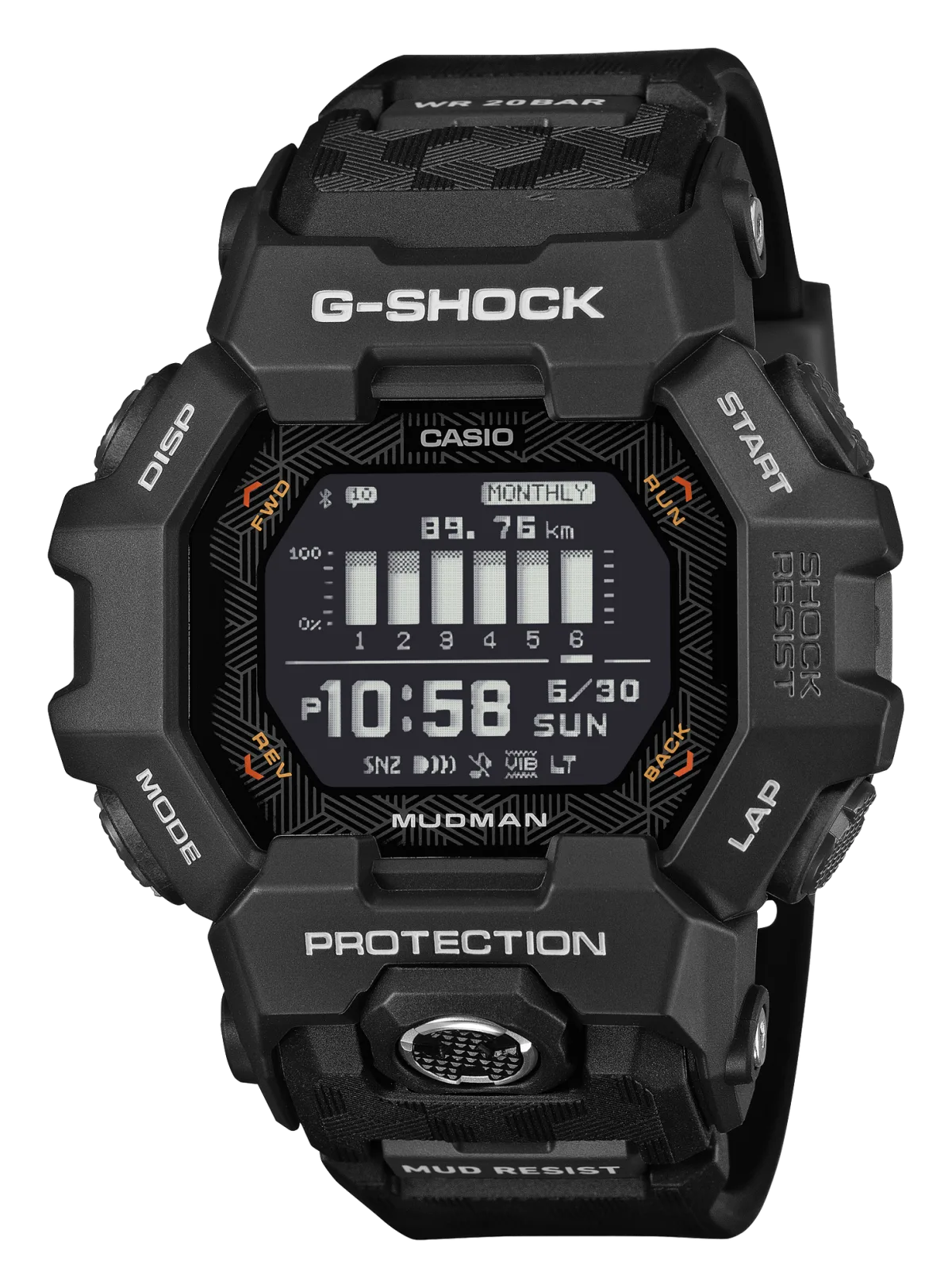
Image: Casio
No paid picks. Ever.
Brands cannot buy a spot.
Sources on every page
Every claim, cited and dated.
We earn a cut, not a say
Affiliate links, clearly marked.
Specs, not vibes
From brand sources, checked twice.
The short version
Casio has split the Mudman in two. The GW-9500 stays the solar instrument watch, and this cheaper, lighter GDG-B100 becomes the connected one for people who care more about pace than altitude.
What is new about the GDG-B100 Mudman?
Casio listed the GDG-B100 on its UK site as a new October 2026 release, in three colourways: black (GDG-B100-1, the version covered here), dark green (GDG-B100-1A3) and sand (GDG-B100-1A5). It is the first Mudman to use a memory-in-pixel (MIP) LCD, the reflective screen type Casio has been working into other G-Shocks. MIP panels get easier to read in bright sunlight rather than harder, which suits a watch meant for building sites, farms and muddy trails. The backlight is a red LED, which Casio says helps your eyes keep their adaptation to the dark when you check the time at night.
The bigger change is what the watch is for. The 2023 GW-9500 Mudman is a solar-powered instrument watch with a compass, altimeter, barometer and thermometer. The GDG-B100 is a Bluetooth training watch instead. An accelerometer counts steps and estimates distance, speed, pace and calories, with auto lap, auto pause, an interval timer and storage for up to 100 runs. Paired with the Casio Watches app, it shows notifications for calls, emails, social media, calendar events and reminders, sets its own time and can find your phone. Gadgets & Wearables describes it as a second branch of the Mudman family rather than a replacement, and the two spec sheets back that reading.
How big is it, and how will it wear?
This is a large watch. Casio quotes 63.6 mm long, 49.6 mm wide and 16.2 mm thick, with a weight of 66 g on its resin band. As a rough guide, anything over 60 mm from end to end tends to sit best on wrists of around 18 cm and up; on a slimmer wrist the bumper bezel will reach past the edges. Casio says the band fits wrists from 145 to 215 mm, so the strap itself will not be the limit.
The weight helps. Gadgets & Wearables puts the GW-9500 at 81 g, so the new model is noticeably lighter despite similar proportions. Casio has also shaped the back bumper bezel to follow the curve of the wrist, which should take some of the edge off that thickness.
What powers it, and how accurate is it?
Inside is quartz module 3587 running on a CR2032 coin cell. Casio estimates around two years of battery life, helped by a power-saving mode that blanks the display for three hours a day. Casio rates the timekeeping at plus or minus 15 seconds a month without the phone link, but once paired, the watch corrects itself automatically over Bluetooth, so day-to-day accuracy should not be a concern.
The training data is more modest than the list of functions suggests. There is no onboard GPS and no heart-rate sensor. Distance comes from the accelerometer, and Casio recommends calibrating it against your phone's GPS; after that, the watch can estimate running distance on its own. Expect a capable run logger, not a substitute for a GPS sports watch.
How well is it built?
The case uses Casio's Carbon Core Guard structure in bio-based carbon and bio-based resin, sandwiched between a multi-faceted front bezel and a back bumper bezel. Casio says the bezel and band interlock to strengthen the band connections, and the button shafts carry gaskets to keep out mud and dust. Water resistance is 200 m, and the watch is rated shock resistant and mud resistant. The case back is engraved with the Mudman mole, and the tread from its boot is echoed on the dial and band.
The crystal is mineral glass rather than sapphire, which is normal for a resin G-Shock at this price but worth knowing if you work around grit and stone.
Is it good value against its rivals?
Notebookcheck reports that Casio UK lists all three colourways at £200. The obvious comparison is Casio's own GW-9500-1ER Mudman, which UK retailers list at £349. That extra money buys Tough Solar and the triple sensor, so it remains the better tool if you need a compass or altimeter. If you would rather have notifications, run tracking and a brighter, sunlight-friendly screen, the GDG-B100 does more for less money and weighs less.
Within G-Shock, Gadgets & Wearables points out that the GBX-H5600 goes further on training with optical heart rate. The GDG-B100 sits below that: a tougher, more outdoor-focused watch with simpler fitness features.
What is the catch?
- No solar. Dropping Tough Solar from a watch built for harsh environments is an odd choice. A two-year coin cell is cheap and easy to replace, but it is still a battery to remember.
- No sensors for the hills. There is no compass, altimeter, barometer or thermometer, which many Mudman buyers will expect.
- Size. At 16.2 mm thick and 63.6 mm long it will not slide under a shirt cuff.
- Too new for owner feedback. The watch has only just reached shops, so there is not yet enough public owner discussion to report long-term themes such as button feel or strap comfort.
“A Mudman for people who log their runs, not their altitude.”
What are the full specs?
| Spec | G-Shock Mudman GDG-B100-1 |
|---|---|
| Brand | Casio |
| Reference | GDG-B100-1 |
| Case diameter | 49.6 mm |
| Thickness | 16.2 mm |
| Lug to lug | 63.6 mm |
| Water resistance | 200 m |
| Movement | Quartz |
| Calibre | Module 3587 |
| Crystal | Mineral glass |
| Strap | Bio-based resin band |
| Colourway | Black bio-based carbon and resin case, MIP LCD, black resin band |
| Launched | October 2026 |
| Brand RRP | £200 |
Specs from the brand's published information. RRP is the brand's own UK price, not an Amazon price.
Questions people ask
Can you swim with the Casio GDG-B100?
Yes. Casio rates it to 200 m of water resistance, which covers swimming and snorkelling. It is not a certified dive watch.
Does the GDG-B100 Mudman have a compass?
No. Unlike the GW-9500 Mudman, it has no compass, altimeter, barometer or thermometer. It focuses on step counting, run tracking and phone notifications instead.
How long does the GDG-B100 battery last?
Casio estimates about two years on a CR2032 coin cell. It is not solar powered, so the cell will need replacing.
Should I buy the GDG-B100 or the GW-9500 Mudman?
Choose the GDG-B100 at £200 if you want notifications, run logging and a MIP screen. Choose the GW-9500, listed around £349 at UK retailers, if you want Tough Solar and the triple sensor.
Where does this come from?
- GDG-B100-1 product page and specifications (opens in a new tab) Casio UK · accessed 14 Nov 2026
- Casio's new MIP-display, red-backlit GDG-B100 Mudman watches arrive in more markets (opens in a new tab) Notebookcheck · accessed 14 Nov 2026
- Casio gives the Mudman a big digital upgrade but drops Tough Solar (opens in a new tab) Gadgets & Wearables · accessed 14 Nov 2026
- Casio unveils first Mudman watches with MIP display, fitness tracking, red backlight (opens in a new tab) Notebookcheck · accessed 14 Nov 2026
Corrections
No corrections since this was published on 14 November 2026.
More digital watches