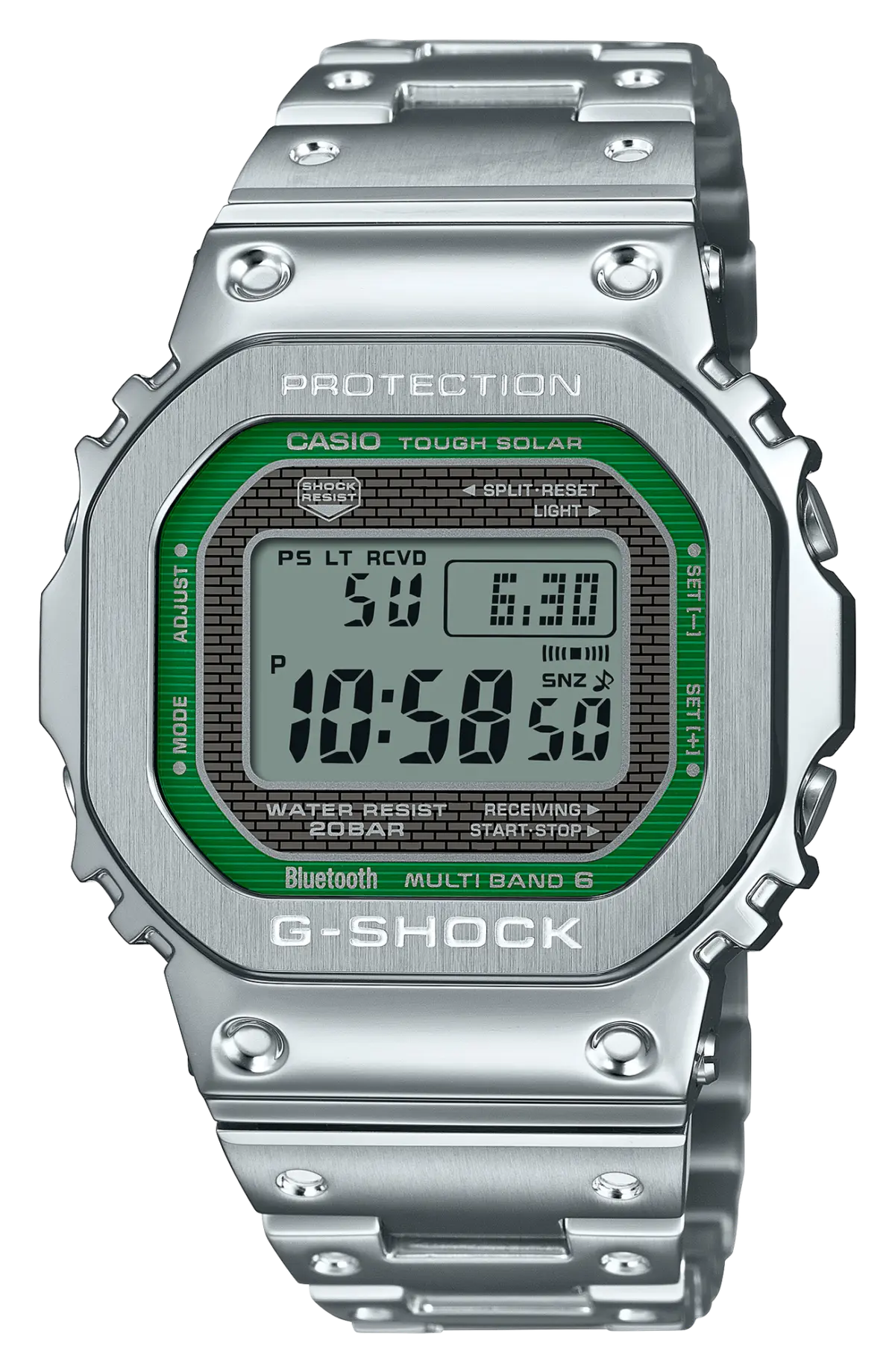
GBD-300 a slimmer G-Shock run logger with a MIP screen
Buy the GBD-300 if you want a light, tough G-Shock that counts steps, logs runs and shows phone notifications on a clear MIP screen. It costs £129 at Watch.co.uk, is water resistant to 200 m and runs about two years on a coin cell. The catch: there is no GPS or heart rate sensor, so distance relies on the accelerometer.
We may earn a commission if you buy through this link. It never changes what we pick or say.
Buy on Amazon (opens Amazon UK in a new tab)- Show Amazon prices from

Image: Casio
No paid picks. Ever.
Brands cannot buy a spot.
Sources on every page
Every claim, cited and dated.
We earn a cut, not a say
Affiliate links, clearly marked.
Specs, not vibes
From brand sources, checked twice.
The short version
G-Shock's G-Squad sports line got slimmer in July 2024. The GBD-300 puts a memory-in-pixel display, Bluetooth and run logging into a 60 g octagonal case with a double bezel.
What is new about the GBD-300?
The GBD-300 is a G-Squad model, the sports branch of G-Shock that adds step counting and phone connectivity to the usual tough resin case. Casio Europe announced it on 18 June 2024 and it went on sale in July 2024 in black (GBD-300-1), white and yellow. This first look covers the black GBD-300-1ER.
The big change from earlier G-Squad watches is size. Casio describes the GBD-300 as slimmer and more compact than its sports siblings, with a simple octagonal shape that echoes the popular 2100 series. Instead of one bulky bezel, the centre case sits between two separate bezels. Casio says the rear "bumper" bezel curves around the case to protect it from knocks and to reduce contact with the back of the hand.
The other headline is the screen. The GBD-300 uses a memory-in-pixel (MIP) LCD, a high-contrast monochrome display that Notebookcheck reports is designed for good visibility in daylight. It is the same display technology Casio has been rolling out across newer digital G-Shocks.
How big is it, and how will it wear?
Casio quotes the case at 48.9 x 47.4 x 14.9 mm, with a total weight of about 60 g. In G-Shock terms that is light and fairly trim, although 14.9 mm is still a chunky watch next to a traditional analogue piece. The octagonal case is close to round in practice, so it should sit flat rather than dig into the wrist.
The band is soft urethane in a bio-based resin, and Casio has given the inner surface a dotted texture. The idea is to stop it slipping and sticking to sweaty skin during exercise. There is also a flexible section where the band meets the bezel, which Casio says follows the movement of the wrist for a more comfortable fit. Watch.co.uk lists the strap width as 27 mm with a 20 mm lug width.
What does it do, and how does it run?
This is not a GPS watch. It uses an accelerometer to count steps and estimate distance, speed, pace and calories, and it can store logs for up to 100 runs. A selectable log view shows step counts for each day of the week or running distance for the month. Pair it with the G-Shock MOVE app over Bluetooth and you can build training plans, review data and use your phone's GPS to correct the watch's distance figures.
Bluetooth also brings notifications for calls, emails, calendar events and social media, which can sound the alarm or vibrate the watch. There is a phone finder too. The everyday functions are what you would expect from a G-Shock: four alarms, a countdown timer, a stopwatch and world time covering 38 cities. The Super Illuminator LED light can switch on automatically with a tilt of the wrist.
Power comes from a CR2032 coin cell, which Casio rates at about two years. Note that one Casio Europe release lists Tough Solar among the features, but Casio America, Watch.co.uk and Watchard all describe a battery-powered watch with a CR2032, so do not expect solar charging.
How well is it built?
It is a G-Shock, so shock resistance is the starting point. The double-bezel structure is designed to protect the module from impacts that would damage ordinary watches. Water resistance is 200 m (20 bar), enough for swimming and snorkelling. Watch.co.uk lists a mineral crystal and a stainless steel caseback fixed with screws, and gives the module number as 3568.
Resin is the right choice for a training watch: it is light, does not mind sweat and will not leave you worrying about scratches.
Is it good value against its rivals?
We could not confirm a Casio UK RRP for this model, so the figure we use is the price Watch.co.uk lists: £129. That places it at the cheaper end of the £100 to £300 band.
The obvious rival from Casio's own range is the GW-BX5600, the square G-Shock with a MIP display, which Notebookcheck reports at £159 on Casio UK. The GW-BX5600 adds solar power and radio time sync, while the GBD-300 brings step tracking and run logs instead. If you want an activity tracker in a G-Shock case, the GBD-300 is the better fit and costs less. If you want a classic square that keeps perfect time with no battery changes, look at the GW-BX5600.
A cheap fitness band will track more, with heart rate and proper sleep data. The GBD-300 trades those features for a far tougher case, 200 m water resistance and a battery that lasts years rather than days.
What is the catch?
There is no GPS and no heart rate sensor, so distance and pace depend on the accelerometer unless you carry your phone. Runners who want accurate splits will be better served by a dedicated GPS watch. And despite the slimmer design, 14.9 mm is still thick enough to catch on a cuff.
For everyday wear, gym sessions and steady runs, though, it offers a readable screen, useful logs and the G-Shock build at a modest price.
“A G-Shock that logs your runs without asking you to charge it every week.”
What do owners say?
Themes from public owner feedback, paraphrased. We never copy Amazon reviews or ratings.
-
Buyers who use it for workouts praise the easy-to-read display, the vibration alarm and simple Bluetooth syncing, and say the pedometer and workout functions work well for gym sessions.
Watchard customer reviews (opens in a new tab)
What are the full specs?
| Spec | G-Shock G-Squad GBD-300 |
|---|---|
| Brand | Casio |
| Reference | GBD-300-1ER |
| Case diameter | 47.4 mm |
| Thickness | 14.9 mm |
| Lug to lug | 48.9 mm |
| Water resistance | 200 m |
| Movement | Quartz |
| Calibre | 3568 |
| Crystal | Mineral |
| Strap | Black bio-based resin band with textured underside |
| Colourway | Black resin case and band, MIP LCD |
| Launched | July 2024 |
| Brand RRP | £129 |
Specs from the brand's published information. RRP is the brand's own UK price, not an Amazon price.
Questions people ask
Does the G-Shock GBD-300 have GPS?
No. It estimates distance with an accelerometer, and the G-Shock MOVE app can use your phone's GPS to correct distance figures.
Is the GBD-300 solar powered?
No. It runs on a CR2032 battery that Casio rates at about two years.
How big is the G-Shock GBD-300?
Casio quotes 48.9 x 47.4 x 14.9 mm and a weight of about 60 g.
Is the GBD-300 waterproof?
It is water resistant to 200 m (20 bar), so it is fine for swimming and snorkelling.
Where does this come from?
- G-SHOCK GBD-300-1 (opens in a new tab) Casio · accessed 14 Oct 2026
- Casio launches G-SHOCK GBD-300 smartwatch to track distance, pace, steps, and calories (opens in a new tab) Notebookcheck · accessed 15 Oct 2026
- New slimline G-Shock smartwatch is designed for running and intense workouts (opens in a new tab) Advnture · accessed 16 Oct 2026
- G-Shock G-Squad GBD-300-1ER (opens in a new tab) Watch.co.uk · accessed 15 Oct 2026
- Casio G-Shock GBD-300-1ER G-Squad watch (opens in a new tab) Watchard · accessed 16 Oct 2026
Corrections
No corrections since this was published on 17 October 2026.
More digital watches